
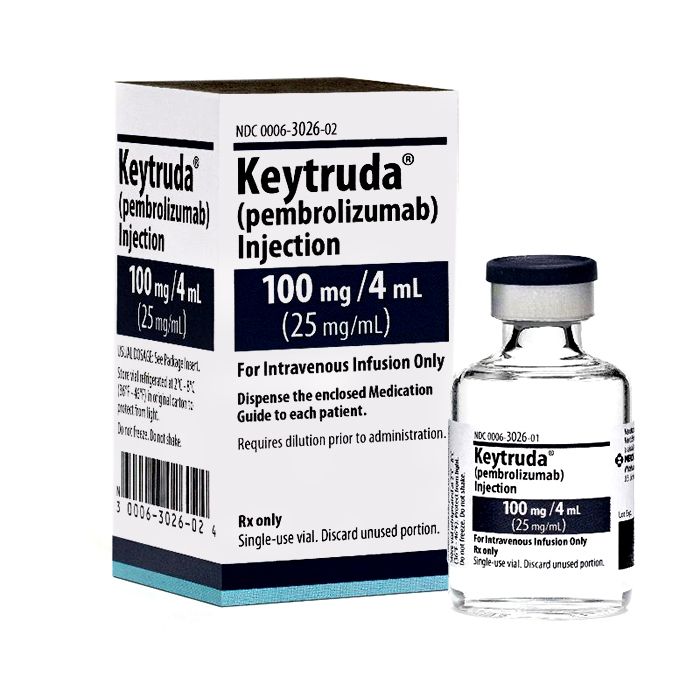
Keytruda (pembrolizumab) 100mg/4ml
£10,840.90
Keytruda (pembrolizumab) is a medication used for the treatment of advanced melanoma, metastatic nonsquamous NSCLC, recurrent or metastatic Head and Neck Squamous Cell Carcinoma (HNSCC), recurrent classical Hodgkin Lymphoma (cHL), locally advanced or metastatic urothelial carcinoma, solid tumours having the biomarkers MSI-H or dMMR, recurrent locally advanced or metastatic gastric or gastroesophageal junction adenocarcinoma, renal cell carcinoma, triple-negative breast cancer.
Category: pembrolizumab
Description
KEYTRUDA is a prescription medicine used to treat:
- a kind of skin cancer called melanoma.
- It may be used when your melanoma has spread or cannot be removed by surgery (advanced melanoma), or
- It may be used in adults and children 12 years of age and older with stage IIB, stage IIC, or stage III melanoma, to help prevent melanoma from coming back after it and lymph nodes that contain cancer have been removed by surgery.
- a kind of lung cancer called non–small cell lung cancer (NSCLC).
- It may be used with the chemotherapy medicines pemetrexed and a platinum as your first treatment when your lung cancer has spread (advanced NSCLC) and is a type called “nonsquamous” and your tumor does not have an abnormal “EGFR” or “ALK” gene.
- It may be used with the chemotherapy medicines carboplatin and either paclitaxel or paclitaxel protein-bound as your first treatment when your lung cancer has spread (advanced NSCLC), and is a type called “squamous.”
- It may be used alone as your first treatment when your lung cancer has not spread outside your chest (stage III) and you cannot have surgery or chemotherapy with radiation, or your NSCLC has spread to other areas of your body (advanced NSCLC), and your tumor tests positive for “PD-L1” and does not have an abnormal “EGFR” or “ALK” gene.
- It may also be used alone for advanced NSCLC if you have tried chemotherapy that contains platinum and it did not work or is no longer working and, your tumor tests positive for “PD-L1” and if your tumor has an abnormal “EGFR” or “ALK” gene, you have also received an “EGFR” or “ALK” inhibitor medicine that did not work or is no longer working.
- a kind of cancer called head and neck squamous cell cancer (HNSCC).
- It may be used with the chemotherapy medicines fluorouracil and a platinum as your first treatment when your head and neck cancer has spread or returned and cannot be removed by surgery.
- It may be used alone as your first treatment when your head and neck cancer has spread or returned and cannot be removed by surgery, and your tumor tests positive for “PD-L1.”
- It may be used alone when your head and neck cancer has spread or returned, and you have received chemotherapy that contains platinum and it did not work or is no longer working.
- a kind of cancer called classical Hodgkin lymphoma (cHL). It may be used
- in adults when:
- your cHL has returned or
- you have tried a treatment and it did not work, or
- in children when:
- you have tried a treatment and it did not work, or
- your cHL has returned after you received 2 or more types of treatment.
- in adults when:
- a kind of cancer called primary mediastinal B-cell lymphoma (PMBCL). It may be used in adults and children when you have tried a treatment and it did not work, or your PMBCL has returned after you received 2 or more types of treatment.
- a kind of bladder and urinary tract cancer called urothelial carcinoma.
- It may be used when your cancer has not spread to nearby tissue in the bladder, but is at high-risk for spreading (high-risk, non-muscle invasive bladder cancer [NMIBC]) and when your tumor is a type called “carcinoma in situ” (CIS), and you have tried treatment with Bacillus Calmette-Guerin (BCG) and it did not work, and you are not able to or have decided not to have surgery to remove your bladder.
- It may be used when your bladder or urinary tract cancer has spread or cannot be removed by surgery (advanced urothelial cancer), and you are not able to receive chemotherapy that contains platinum (medicines called either cisplatin or carboplatin).
- It may be used when your bladder or urinary tract cancer has spread or cannot be removed by surgery (advanced urothelial cancer), and you have received chemotherapy that contains platinum, and it did not work or is no longer working.
- a kind of cancer that is shown by a laboratory test to be a microsatellite instability-high (MSI-H) or a mismatch repair deficient (dMMR) solid tumor. It may be used in adults and children to treat:
- cancer that has spread or cannot be removed by surgery (advanced cancer), and
- has progressed following treatment, and you have no satisfactory treatment options.
- This use is approved based on how many patients responded to treatment and how long they responded. Studies are ongoing to provide additional information about clinical benefit.
It is not known if KEYTRUDA is safe and effective in children with MSI-H cancers of the brain or spinal cord (central nervous system cancers).
- a kind of cancer called colon or rectal cancer. It may be used when your cancer:
- has spread or cannot be removed by surgery (advanced colon or rectal cancer), and
- has been shown by a laboratory test to be microsatellite instability-high (MSI-H) or mismatch repair deficient (dMMR).
- a kind of stomach cancer called gastric or gastroesophageal junction (GEJ) adenocarcinoma.
- It may be used with the medicine trastuzumab with fluoropyrimidine and platinum chemotherapy as your first treatment when your stomach cancer:
- Is HER2-positive, and
- has spread or cannot be removed by surgery (advanced gastric cancer).
- It may be used with the medicine trastuzumab with fluoropyrimidine and platinum chemotherapy as your first treatment when your stomach cancer:
- This use is approved based on how many patients responded to treatment and how long they responded. Studies are ongoing to provide additional information about clinical benefit.
- a kind of cancer called esophageal or certain gastroesophageal junction (GEJ) carcinomas that cannot be cured by surgery or a combination of chemotherapy and radiation therapy.
- It may be used with platinum- and fluoropyrimidine-based chemotherapy medicines.
- It may be used alone when:
- you have received one or more types of treatment, and it did not work or it is no longer working, and
- your tumor is a type called “squamous,” and
- your tumor tests positive for “PD-L1.”
- a kind of cancer called cervical cancer that tests positive for “PD-L1.”
- It may be used with chemotherapy medicines, with or without the medicine bevacizumab, when your cervical cancer does not go away (persistent), has returned, or has spread (advanced cervical cancer).
- It may be used alone when your cervical cancer:
- has returned, or has spread or cannot be removed by surgery (advanced cervical cancer), and
- you have received chemotherapy, and it did not work or is no longer working.
- a kind of liver cancer called hepatocellular carcinoma. It may be used after you have received the medicine sorafenib.
- This use is approved based on how many patients responded to treatment and how long they responded. Studies are ongoing to provide additional information about clinical benefit.
- a kind of skin cancer called Merkel cell carcinoma (MCC) in adults and children. It may be used when your cancer has spread or returned.
- This use is approved based on how many patients responded to treatment and how long they responded. Studies are ongoing to provide additional information about clinical benefit.
- a kind of kidney cancer called renal cell carcinoma (RCC).
- It may be used with the medicine axitinib as your first treatment when your kidney cancer has spread or cannot be removed by surgery (advanced RCC).
- It may be used alone if you are at intermediate-high or high risk of your kidney cancer (RCC) coming back after surgery to:
- remove all or part of your kidney, or
- remove all or part of your kidney and also surgery to remove cancer that has spread to other parts of the body (metastatic lesions).
- a kind of skin cancer called cutaneous squamous cell carcinoma (cSCC). It may be used when your skin cancer has returned or spread, and cannot be cured by surgery or radiation.
- a kind of cancer called triple-negative breast cancer (TNBC).
- It may be used with chemotherapy medicines as treatment before surgery and then continued alone after surgery when you have early-stage breast cancer, and are at high risk of your breast cancer coming back (high-risk early-stage triple-negative breast cancer [TNBC]).
- It may be used with chemotherapy medicines when your breast cancer has returned and cannot be removed by surgery or has spread (advanced TNBC), and tests positive for “PD-L1.
Be the first to review “Keytruda (pembrolizumab) 100mg/4ml” Cancel reply
Reviews
There are no reviews yet.